Pure Future dramatically increases microalgae production with GLS LED lighting
High-intensity PROGROW 4800 HB lighting helps transform productivity in commercial algae photobioreactors
- Customer
- Pure Future
- Application
- Controlled-environment microalgae cultivation
- Cultivation system
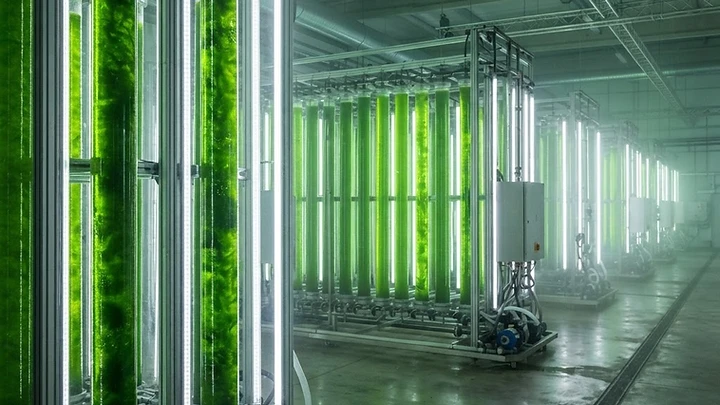
- LGem photobioreactors (PBRs)
- Lighting solution
- GLS PROGROW 4800 HB
- Primary objective
- Increase available photosynthetic light and accelerate algae production
The result
After evaluating multiple LED lighting approaches for its photobioreactor systems, Pure Future worked with GLS to implement a substantially higher-output GLS lighting solution. The impact on production was dramatic.
Pure Future's testing found that GLS lighting substantially reduced both inoculation time and repeated production-cycle time compared with the other lighting systems evaluated. More importantly, Pure Future reports that the resulting increase in productivity changed the economics of the entire lighting decision.
Despite the greater maximum power capability of the GLS lighting system, Pure Future concluded that the combination of dramatically higher productivity, shorter production cycles and intelligent light-level control made the GLS solution more cost-effective from both a CAPEX and OPEX perspective.
The challenge: light was limiting photobioreactor productivity
Pure Future cultivates proprietary algae strains in controlled photobioreactor systems. Unlike conventional greenhouse or indoor crop production, photobioreactor lighting presents a unique engineering challenge.
As microalgae multiply inside a reactor, the culture itself increasingly absorbs and attenuates incoming light. Light that reaches the outside of a reactor is not necessarily the same amount of photosynthetically active radiation available deeper within the culture.
That means the optimal lighting system needs to do more than illuminate the reactor. It needs to provide sufficient photosynthetic photon output to support rapidly increasing culture density — while avoiding excessive light when the culture is young and does not yet require the system's full output.
Pure Future experimented with several LED lighting solutions in an effort to improve this balance. The systems evaluated included the original UFO lights, LGem Pilot 1100 lighting, generic OEM grow lights and the high-output GLS solution. The comparison revealed a significant difference in the amount of photosynthetically active light available from the GLS system.
The GLS solution: high photon output when the culture needs it
Pure Future worked with GLS to upgrade its photobioreactor lighting using the GLS PROGROW 4800 HB platform.
The advantage was not simply operating the lights at maximum output continuously. Instead, Pure Future incorporated the GLS lighting into a feedback-controlled system that adjusts lighting according to the amount of photosynthetically active light passing through the algae culture. A quantum PAR sensor measures light passing through the algae, and the system controls the lighting to maintain a target pass-through level of approximately 300 according to Pure Future's testing methodology.
This approach is designed to accomplish two objectives:
- Early in the cycle: avoid delivering unnecessary light when the algae culture is less dense and reduce the risk of photoinhibition.
- As culture density increases: provide substantially more light as the growing algae population absorbs more of the incident photosynthetic radiation.
The result is a dynamic lighting strategy in which the available photon output can increase along with the biological demand of the culture.
High maximum output doesn't mean maximum power all the time
One of the most important findings from Pure Future's testing concerns energy use. A high-output lighting system might initially appear less efficient if the analysis considers only its maximum electrical power. But maximum fixture wattage does not describe how the system operates throughout an algae production cycle.
Pure Future reports that the GLS lights typically operate at minimum power for approximately 27–30% of the production cycle. The lights operate at maximum power for only approximately 34–40% of the cycle. During the remaining portion of the cycle, output can respond to the light available through the culture.
The objective is not: use the least power at every moment.
It is: deliver the appropriate amount of photosynthetic light at each stage of the production cycle to maximize total system productivity.
Dramatically shorter production cycles
The effect of the higher-output GLS lighting became evident in Pure Future's production testing. Compared with the other lighting systems evaluated, the GLS solution dramatically reduced both inoculation time and repeated cycle time.
That distinction is commercially important. A lighting system that reduces the time required to reach the desired culture condition can allow the same photobioreactor infrastructure to complete more production cycles over a given period.
Instead of evaluating lighting only in terms of watts per light, or even photons per watt, Pure Future's experience points toward another critical commercial metric: production per unit of time. When expensive cultivation infrastructure such as a photobioreactor can produce more output over the same week, month or year, the economics can change dramatically.
More than 2,000% greater production per period in some examples
According to Pure Future's internal comparison, the GLS lighting system increased production per period by more than 2,000% in some examples.
That is an extraordinary result, and one that demonstrates why evaluating controlled-environment lighting strictly on fixture wattage can be misleading. The GLS system has greater maximum power capability than the lower-output lighting solutions Pure Future evaluated. But the additional photon availability dramatically reduced production time, which means Pure Future could generate substantially more production from its photobioreactor infrastructure over a given period.
The company's conclusion was significant: the increased productivity and reduced production time made the more energy-intensive GLS lights more cost-effective from both a CAPEX and OPEX perspective.
Why more light can change photobioreactor economics
Commercial algae production requires investment in far more than lighting. Photobioreactors, pumps, controls, sensors, cooling systems, space, labor and supporting infrastructure all contribute to the capital and operating cost of a production system.
If insufficient lighting causes that equipment to spend substantially longer completing each biological production cycle, the economic penalty extends far beyond the electricity consumed by the lights. Increasing photon availability can therefore create value in several ways:
- Faster inoculation can reduce the time required to establish productive cultures.
- Shorter repeat cycles can increase the number of production cycles possible from the same reactor infrastructure.
- Higher production per period can increase the utilization of installed PBR capacity.
- Closed-loop lighting control can reduce unnecessary electrical consumption when full light output is not biologically required.
- Higher available photon output provides additional lighting capacity as cultures become denser and increasingly light-limited.
This is why the lowest-wattage lighting solution is not necessarily the lowest-cost production solution.
Managing photoinhibition with closed-loop lighting control
Pure Future's approach also demonstrates why simply applying maximum light intensity throughout the entire algae production cycle is not the objective. Too much light at the wrong stage can cause photoinhibition while consuming energy that the culture cannot effectively use.
Pure Future's system uses a quantum PAR measurement to monitor the light passing through the algae culture and regulates lighting accordingly. According to the company's testing, the target was approximately 300 PAR pass-through.
This feedback-loop approach allows the lighting system to remain at relatively low output when the biological demand is low and increase output as culture density rises. High-output capability and intelligent dimming work together: the high-output GLS fixtures provide the available photon capacity, and the feedback system determines when that capacity is actually needed.
Additional optimization may produce even greater gains
Pure Future's work with GLS is continuing. The company has also experimented with reflective Mylar around the reactor system to redirect additional photosynthetically active light toward the algae. Initial results from that approach were described as favorable, although the additional captured light also increased cooling requirements. Pure Future believes that improvements to cooling and temperature-control systems could enable still greater production results.
This highlights an important principle of controlled-environment biological production: lighting cannot be optimized in isolation. As photosynthetic productivity increases, thermal management, temperature control, fluid circulation, nutrient availability and other process variables can become the next limiting factors. The goal is therefore not simply to install a brighter light — it is to optimize the entire biological production system around the increased availability of photons.
From grow lighting to photosynthetic biotechnology
The Pure Future project demonstrates the broader potential of GLS technology. PROGROW fixtures were developed around the challenge of delivering large quantities of photosynthetically useful light efficiently and reliably in controlled environments. Plants are not the only photosynthetic organisms that can benefit from that capability. Microalgae cultivation presents many of the same fundamental requirements — but in a very different production architecture.
For commercial photobioreactors, the relevant questions include:
- How much photosynthetically active light is available to the culture?
- How effectively does that light penetrate as culture density increases?
- Can light intensity respond to changing biological demand?
- How quickly can the culture reach its production target?
- How many production cycles can the installed reactor infrastructure complete?
- And ultimately, how much product can the system generate per unit of time and total operating cost?
Pure Future's experience demonstrates what can happen when lighting is evaluated at the production-system level rather than simply at the fixture level.
Planning a high-intensity lighting layout?
Talk to our team about PROGROW fixtures, controls and what they could do in your facility.
Get started