AlphaLeaf boosts cannabis yield and flower quality with GLS top lighting + under-canopy lighting
Montreal cultivator builds a more complete lighting strategy with PROGROW 2400 HB top lighting and GLS under-canopy LEDs
- Customer
- AlphaLeaf Corporation
- Location
- Montreal, Quebec, Canada
- Application
- Indoor commercial cannabis cultivation
- Top lighting
- GLS PROGROW 2400 HB
- Under-canopy lighting
- GLS LED under-canopy lighting
- Top-lighting conversion
- Early 2025
- Under-canopy installation
- Early 2026
The results
Across multiple strains, AlphaLeaf reports that adding GLS under-canopy lighting to its existing GLS PROGROW 2400 HB top-lighting system produced substantial improvements in harvest weight. The company also observed improved flower-size uniformity where comparative grading data was available.
Among three documented before-and-after strain comparisons:
- Banana Cream: Dry yield increased 50%, from 40 kg to 60 kg. The percentage of “bigs” increased from 19% to 35%, while “smalls” fell from 6% to 3%.
- MAC Deluxe: Dry yield increased 17.5%, from 40 kg to 47 kg.
- Ice Cream: Dry yield increased from 36 kg to 111 kg — a 208% increase. Wet harvest weight increased from 240 kg to 451 kg, an increase of approximately 88%.
The results illustrate the potential value of treating commercial cannabis lighting as a whole-canopy system rather than relying exclusively on light delivered from above.
The challenge: getting more productive light deeper into the cannabis canopy
AlphaLeaf Corporation operates a controlled indoor cultivation facility in Montreal, Quebec, producing premium cannabis flower with a focus on quality and consistency.
In early 2025, AlphaLeaf transitioned its primary top lighting to GLS PROGROW 2400 HB LED luminaires. The next opportunity was deeper in the canopy.
Cannabis develops a dense plant structure during flowering. Even with high-intensity top lighting, upper leaves and flowers intercept a substantial portion of the available light. As a result, flowers deeper in the canopy can receive significantly less photosynthetic light than flowers near the top of the plant.
For a commercial cultivator, this creates two related challenges:
- Yield: Lower-canopy flowers may not receive enough light to maximize biomass production.
- Uniformity: Uneven light exposure can contribute to substantial differences in flower size and development between the upper and lower canopy.
AlphaLeaf wanted to determine whether adding light beneath the canopy could turn more of that lower plant area into productive, higher-quality flower.
The GLS solution: top light + under-canopy light
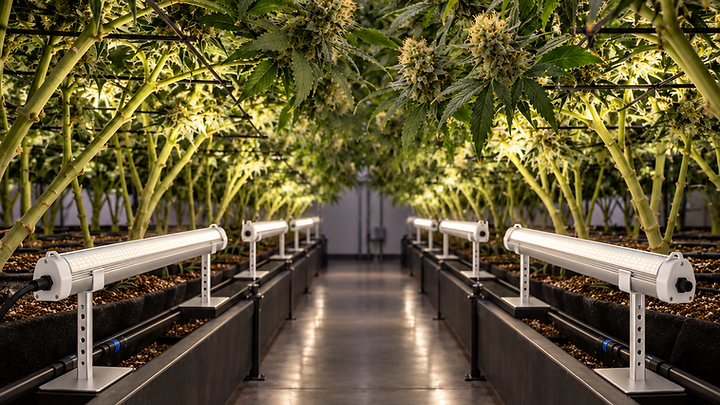
In early 2026, AlphaLeaf added GLS under-canopy LED lighting to cultivation rooms already operating with PROGROW 2400 HB top lights.
Instead of asking top lighting to do all the work, the combined system attacks the lighting challenge from two directions.
- PROGROW 2400 HB top lights deliver high-intensity photosynthetic light to the primary canopy from above.
- GLS under-canopy lights supplement areas below the upper canopy where top light has been intercepted by leaves and flowers.
The objective is not simply to add more watts to the room. It is to place additional photons where the crop can use them — increasing light availability in parts of the plant that would otherwise remain comparatively shaded.
The harvest results reported by AlphaLeaf show why that distinction matters.
Banana Cream: 50% more dry flower — and dramatically better flower-size distribution
The Banana Cream comparison provides the clearest example of both increased yield and improved flower uniformity.
- Wet harvest weight
- 280 kg
- Dry harvest weight
- 40 kg
- Smalls
- 6%
- Bigs
- 19%
- Wet harvest weight
- 360 kg
- Dry harvest weight
- 60 kg
- Smalls
- 3%
- Bigs
- 35%
The addition of under-canopy lighting corresponded with a 50% increase in dry flower mass, from 40 kg to 60 kg. But the improvement went beyond total kilograms.
The share of flower classified as “bigs” increased from 19% to 35%, an increase of more than 84% in the relative share of large flowers. At the same time, “smalls” were cut in half, from 6% to 3%.
This is important commercially because maximizing cultivation performance is not simply about producing more biomass. The distribution and uniformity of that biomass can also matter.
AlphaLeaf's Banana Cream results suggest that increasing light availability deeper in the canopy helped the crop produce not only more flower, but a greater proportion of larger flowers.
MAC Deluxe: 17.5% increase in dry yield
The MAC Deluxe strain also showed a positive response after GLS under-canopy lighting was installed.
- Wet harvest weight
- 242 kg
- Dry harvest weight
- 40 kg
- Wet harvest weight
- 287 kg
- Dry harvest weight
- 47 kg
That represents an approximately 18.6% increase in wet harvest weight and a 17.5% increase in dry harvest weight.
Flower-size grading data was not available for this comparison, so no claim about changes in flower uniformity is being made for the MAC Deluxe run.
Nevertheless, the increased harvested mass provides another strain-specific example of improved production following the addition of under-canopy light.
Ice Cream: a dramatic increase in harvest mass
The largest response among the three comparisons occurred with the Ice Cream strain.
- Wet harvest weight
- 240 kg
- Dry harvest weight
- 36 kg
- Wet harvest weight
- 451 kg
- Dry harvest weight
- 111 kg
Wet harvest weight increased approximately 88%, from 240 kg to 451 kg.
Even more strikingly, reported dry harvest weight increased from 36 kg to 111 kg — an increase of approximately 208%, or more than three times the previous dry yield.
Because flower-size grading data was not available for these runs, no before-and-after uniformity claim is made for Ice Cream.
The magnitude of the yield difference also makes appropriate context important. Commercial cannabis yields can be influenced by genetics, plant density, crop management, environment, irrigation, nutrition and other variables in addition to lighting. These results represent AlphaLeaf's reported before-and-after production data rather than a controlled scientific trial.
Even with that qualification, the Ice Cream comparison provides a compelling real-world example of the potential production gains associated with getting more light into previously under-lit portions of a productive cannabis canopy.
Three strains. One consistent direction.
The magnitude of improvement differed by cultivar, which is not surprising. Cannabis genetics can respond differently to light intensity, environment and cultivation practices.
But across all three documented comparisons, harvest mass increased after GLS under-canopy lighting was introduced.
| Strain | Dry weight before | Dry weight after | Change |
|---|---|---|---|
| Banana Cream | 40 kg | 60 kg | +50.0% |
| MAC Deluxe | 40 kg | 47 kg | +17.5% |
| Ice Cream | 36 kg | 111 kg | +208.3% |
The data also show why commercial lighting decisions should not be based on a single universal yield-improvement percentage.
The better conclusion is that supplemental under-canopy lighting increased harvested mass across each of the three strains AlphaLeaf compared, with the magnitude of the response varying substantially by strain and crop run.
Why under-canopy lighting can matter
Cannabis lighting has traditionally been designed almost entirely around light delivered from above. That makes intuitive sense: the top of the canopy is closest to the luminaires and receives the highest light intensity.
But a mature cannabis canopy is three-dimensional.
As the crop develops, leaves and flowers in the upper canopy intercept photons that would otherwise penetrate deeper into the plant. Increasing top-light intensity alone does not necessarily provide the most effective way to deliver additional light to shaded lower-canopy tissue.
Under-canopy lighting changes the geometry.
By positioning efficient LED light sources beneath the upper canopy, cultivators can deliver additional photosynthetic light directly into areas that receive less top light.
The goal is a more completely illuminated crop — not merely a brighter ceiling.
Yield is only part of the opportunity
The Banana Cream results highlight another potential advantage of a more complete lighting strategy: flower-size uniformity.
Commercial cannabis cultivation does not necessarily assign equal value to every gram of harvested biomass. Flower size, structure, appearance and uniformity can influence downstream grading, processing and product strategy.
Before under-canopy lighting, only 19% of the Banana Cream harvest in the reported comparison was categorized as bigs. After the GLS under-canopy installation, that figure reached 35%. At the same time, the share categorized as smalls fell from 6% to 3%.
That means the lighting change was associated not only with more total dry flower, but also with a substantial shift toward the larger-flower category in this particular comparison.
A whole-canopy approach to commercial cannabis lighting
The AlphaLeaf project represents an evolution in how GLS approaches commercial cannabis lighting. The question is no longer simply:
“How much light can we deliver from above?”
A more useful question is: “How do we deliver the right amount of photosynthetic light throughout the productive canopy?”
For AlphaLeaf, the answer combines high-performance PROGROW 2400 HB top lighting with strategically positioned GLS under-canopy lighting.
Together, the two lighting layers create a more complete approach to canopy illumination — one designed around crop productivity rather than fixture placement alone.
Customer perspective
The addition of GLS under-canopy lighting has produced impressive results across strains, including both higher yields and improved flower-size uniformity.
The individual strain data show that the magnitude of response varies, but the overall direction across the documented comparisons is clear: each strain produced more harvested mass following the introduction of under-canopy lighting.
Key results
| Strain | Dry yield | Wet weight |
|---|---|---|
| Banana Cream | 40 → 60 kg (+50%) | 280 → 360 kg (+28.6%) |
| MAC Deluxe | 40 → 47 kg (+17.5%) | 242 → 287 kg (+18.6%) |
| Ice Cream | 36 → 111 kg (+208.3%) | 240 → 451 kg (+87.9%) |
Banana Cream flower-size distribution: bigs 19% → 35%; smalls 6% → 3%.
The commercial takeaway
AlphaLeaf's results demonstrate why the next generation of commercial cannabis lighting may need to be evaluated as a whole-canopy lighting system.
High-performance top lighting remains the foundation. But once the upper canopy is receiving substantial photosynthetic light, the next opportunity may be the part of the crop that conventional overhead lighting struggles to reach.
For AlphaLeaf, adding GLS under-canopy lighting to its PROGROW 2400 HB top-lighting system was followed by higher harvested mass across three different strains, with particularly large gains in Banana Cream and Ice Cream. And where flower-size data was available, the results went beyond kilograms: Banana Cream produced more large flowers and fewer small flowers.
That combination — higher yield plus greater flower-size uniformity — represents a powerful opportunity for commercial cultivators seeking to generate more value from every square foot of canopy.
Interested in under-canopy lighting?
GLS designs commercial cannabis lighting systems around the crop — from high-intensity top lighting to supplemental under-canopy illumination. Talk with GLS about a top-lighting and under-canopy lighting strategy for your facility.
Results described in this case study were reported by AlphaLeaf based on production runs at its cultivation facility. Before-and-after crop runs are not controlled scientific trials. Yield, flower size and crop quality can be affected by genetics, plant density, environmental conditions, irrigation, nutrition, crop management, lighting intensity and distribution, and other factors. Results at other facilities may vary.
Talk with us about a whole-canopy lighting strategy
GLS can work with cultivators to evaluate existing PPFD, canopy structure, fixture placement, electrical capacity and production objectives to determine where additional light can create the greatest opportunity.
Talk to our team